Preserving Harmony in Riau’s Forests: Monitoring Wild Elephants as the Key to Coexistence
Monitoring Sumatran Elephants in Riau: Protecting Wildlife, Forests, and Communities
Deep within the lowland forests of Riau Province, among towering meranti trees and winding rivers, lives one of Sumatra’s most iconic and magnificent mammals: the Sumatran Elephant (Elephas maximus sumatranus).
Yet the future of these elephants is increasingly uncertain.
Habitat loss and fragmentation, declining food resources, illegal hunting, and the growing overlap between elephant habitat and human activities are placing increasing pressure on wild elephant populations.
In this context, wild elephant monitoring is no longer simply a conservation activity. It is a critical foundation for protecting elephant populations, understanding their ecological needs, and reducing the risk of human–elephant conflict.
Why Elephant Monitoring Matters More Than Ever
Elephants are widely recognized as an important keystone species and ecosystem engineer. Their movements can create pathways through dense vegetation, while their feeding activities and seed dispersal contribute to forest regeneration and ecological processes.
Protecting elephants therefore means protecting more than a single species. Their survival is closely connected to the health and connectivity of the ecosystems they inhabit.
The Sumatran Elephant is classified as Critically Endangered on the IUCN Red List. Current widely cited estimates suggest that approximately 2,400–2,800 individuals remain across Sumatra, although population estimates vary among landscapes and continue to require updated field assessments.
In Riau, elephant populations have experienced severe declines over past decades, while remaining groups are increasingly confined to fragmented forest landscapes.
Without systematic monitoring, it is difficult to determine how many elephants remain, where they move, which habitats they depend upon, and what threats they encounter.
Good conservation begins with good information.
Without reliable data, conservation planning risks becoming a matter of assumption rather than evidence.
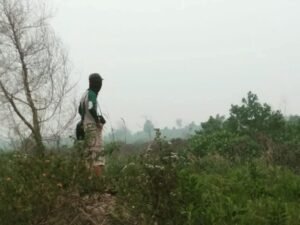
How Wild Elephant Monitoring Works
Monitoring wild elephants involves far more than searching for animals in the forest.
It combines field surveys, ecological observations, technology, mapping, community participation, and collaboration among conservation agencies and other stakeholders.
1. Ground Surveys and Field Tracking
Field teams conduct surveys and patrols within forests, along forest edges, and in areas known to be used by elephants.
They document signs such as:
- footprints;
- dung;
- feeding remains;
- damaged or broken vegetation;
- movement trails; and
- vocalizations and other signs of elephant presence.
Footprints and other field signs can provide valuable information about elephant presence, movement, and group activity.
Dung can also provide important ecological information, including clues about diet and habitat use.
Although modern technology has transformed wildlife monitoring, field observation remains fundamental. Direct evidence collected on the ground provides essential context for interpreting data from GPS collars, camera traps, drones, and other technologies.
2. GPS and Satellite Collars: Following Elephant Movements
One of the most valuable technologies used in elephant monitoring is the GPS or satellite collar.
When safely fitted to selected elephants, these devices can transmit location data at regular intervals, allowing monitoring teams to study movement patterns across large landscapes.
The data can help reveal:
- daily and seasonal movements;
- home-range patterns;
- frequently used routes;
- habitat preferences;
- changes in movement patterns; and
- proximity to agricultural areas and human settlements.
In Riau, GPS collar technology has been used to study Sumatran Elephant movements and to support efforts to better understand and mitigate human–elephant conflict.
The greatest value of this information is not simply knowing where an elephant is.
It is understanding why it is there, where it is likely to go next, and how people can be prepared before a conflict occurs.
When reliable movement information is integrated into an early-warning system, communities can receive advance notification when elephants approach areas of human activity.
This creates an opportunity to prevent conflict rather than responding only after it has already occurred.
3. Camera Traps: Monitoring Without Disturbance
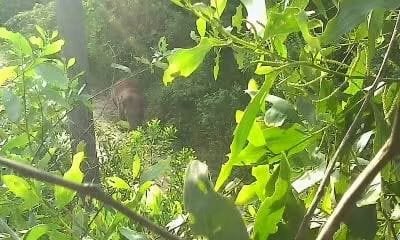
Camera traps provide another important tool for monitoring wild elephants.
Motion-activated cameras can be placed along frequently used trails, movement routes, forest corridors, and other areas with evidence of elephant activity.
Operating continuously, they can document elephant presence without requiring people to be physically present.
Camera-trap images can help researchers and conservation teams:
- confirm elephant presence;
- document group composition;
- record calves and changes in herd structure;
- identify individuals through distinctive physical characteristics;
- monitor repeated use of particular areas; and
- document visible injuries or abnormal physical conditions.
When combined with ground surveys and GPS data, camera traps provide a more complete picture of elephant populations and their movements.
4. Community-Based Monitoring and Institutional Collaboration
No monitoring system can be fully effective if it depends on a single institution.
Communities living near elephant habitat are often among the first to observe changes in elephant movements.
Farmers, village residents, forest patrol groups, and community-based wildlife protection teams can serve as additional eyes and ears on the ground.
Reports of:
- elephant sightings;
- fresh footprints;
- crop damage;
- movement direction;
- or elephant activity near settlements
can provide valuable information for monitoring teams and early-warning systems.
Effective conservation therefore depends on collaboration among local communities, BBKSDA Riau, local governments, forest managers, researchers, law-enforcement agencies, and conservation organizations.
When information is shared rapidly and responsibly, communities can respond earlier and conservation teams can make better-informed decisions.
What Monitoring Reveals
Long-term monitoring provides much more than a record of elephant sightings.
It allows us to understand how elephants respond to changes in their environment and how human activities are affecting their movements.
Migration and Movement Routes Are Under Increasing Pressure
Elephants naturally move across large areas in search of food, water, shelter, and safe habitat.
However, forest fragmentation caused by plantations, roads, settlements, and other land uses can disrupt these movement routes.
When traditional routes are blocked, elephants may be forced into increasingly narrow or altered pathways, increasing the likelihood of encounters with human activities.
In Riau, several important elephant movement corridors have been identified as requiring continued protection and management, including landscapes associated with Tesso–Taranegra, Tahura, and Balai Raja.
Maintaining connectivity between remaining forest blocks is therefore an essential part of long-term elephant conservation.
Elephants Do Not Enter Farms Simply by Choice
Human–elephant conflict is often described as a problem caused by elephants entering agricultural areas.
But the reality is more complex.
As natural habitat becomes smaller and fragmented, and as access to natural food and water changes, elephants may increasingly move through human-dominated landscapes.
Agricultural crops can provide an attractive alternative source of food, creating conditions in which elephants and people come into direct contact.
The consequences can be severe for both sides.
Farmers may experience crop losses and economic hardship, while elephants may face injury, retaliation, or death.
For this reason, human–elephant conflict should not be viewed solely as an issue of elephant behavior.
It is also a landscape and habitat-management issue.
Hidden Threats Can Be Detected Through Monitoring
Some of the greatest threats to elephants may not be immediately visible.
Systematic monitoring can help identify signs of injury, illegal hunting, snares, changes in herd composition, or the disappearance of individuals.
For a species already facing population decline and habitat fragmentation, the loss of even a small number of individuals can have significant consequences.
Elephants also live in highly social family groups. The loss of an individual may therefore affect not only population numbers but also the social structure and functioning of the group.
Monitoring provides an opportunity to detect these changes and respond before threats become even more severe.
Monitoring Builds Bridges, Not Walls
Ultimately, elephant monitoring is about more than locating elephants.
It is about creating the knowledge necessary for coexistence between people and wildlife.
Reliable monitoring data can help identify:
- forests that require stronger protection;
- movement corridors that need restoration;
- areas requiring early-warning systems;
- communities that require additional support;
- locations where preventive measures may be necessary; and
- landscapes where human activities are increasing pressure on elephant habitat.
The goal is not to build an ever-growing wall between people and elephants.
The goal is to maintain enough safe and connected habitat so that elephants can continue moving through the landscape without being forced into frequent conflict with people.
From Data to Conservation Action
Monitoring only becomes meaningful when data are translated into action.
Information about elephant populations, movement patterns, habitat use, threats, and conflict locations can provide an evidence base for conservation planning and land-use management.
Long-term monitoring also allows conservation practitioners to compare conditions over time.
Are elephant movements changing?
Are particular corridors still being used?
Are conflict incidents increasing or decreasing?
Are restoration efforts working?
Are elephant populations stable?
These are questions that cannot be answered reliably without consistent data.
Monitoring transforms conservation from reaction into prevention.
A Future We Can Still Protect
Every footprint recorded, every GPS location transmitted, every camera-trap photograph captured, and every community report submitted represents another piece of information about the future of the Sumatran Elephant.
Monitoring is the beginning of conservation because we cannot effectively protect what we do not understand.
But monitoring alone is not enough.
It must be accompanied by:
- habitat protection;
- restoration of ecological corridors;
- prevention of illegal hunting;
- effective human–elephant conflict mitigation;
- law enforcement;
- responsible land-use planning;
- early-warning systems; and
- meaningful participation from local communities.
The Sumatran Elephant is more than an icon of Sumatra’s natural heritage.
It is part of the ecological systems that sustain forests, watersheds, biodiversity, and human communities.
Protecting elephant habitat means protecting the forest.
Protecting the forest means protecting our shared future.
With consistent monitoring, reliable data, strong collaboration, and meaningful habitat protection, there is still an opportunity to secure a future in which Sumatran Elephants continue to roam freely through connected forests.
A future in which our children and grandchildren will not know these magnificent animals only through photographs and books—but will still have the chance to hear their deep rumble, follow their footprints, and witness them moving peacefully through the forests that have always been their home.
References
- IUCN Red List of Threatened Species — Elephas maximus and the conservation status of Asian elephants.
- WWF — Sumatran Elephant (Elephas maximus sumatranus): population, habitat, ecological importance, and threats.
- Wildlife Conservation Society (WCS) Indonesia — Sumatran Elephant conservation, habitat, and threats.
- Sumatran Elephant Project — Human–Elephant Conflict and conservation approaches in Sumatra.
- Journal of Global Sustainable Agriculture — Research on Sumatran Elephant movements using GPS collar technology.
- WWF-Indonesia — Information on important elephant habitats and movement corridors in Riau.