SUMATRAN ELEPHANT MORTALITY CASES IN RIAU — 2026
From January through early September 2026, two publicly documented cases of wild Sumatran elephant (Elephas maximus sumatranus) mortality were reported and investigated by authorities in Riau Province.
The cases highlight two serious and ongoing threats to the province’s remaining wild Sumatran elephant population: illegal ivory-driven poaching and indiscriminate snaring and trapping. Both threats are particularly concerning for a species classified as Critically Endangered.
CASE 1: ADULT ELEPHANT FOUND DEAD — POACHING AND IVORY TRAFFICKING
February 2026
In early February 2026, residents discovered the carcass of an adult wild elephant within the concession area of PT Riau Andalan Pulp and Paper (PT RAPP), in Lubuk Kembang Bunga Village, Ukui Sub-district, Pelalawan Regency, Riau.
Based on the investigation, the elephant was believed to have died in late January 2026, several days before the carcass was discovered.
The condition of the carcass indicated a serious wildlife crime. The head had been severed, both tusks had been removed, and the eyes and trunk had also been cut away. Post-mortem and forensic examinations reportedly recovered two projectile rounds embedded in the head, establishing that the elephant had been shot.
Source: kehutanan.go.id
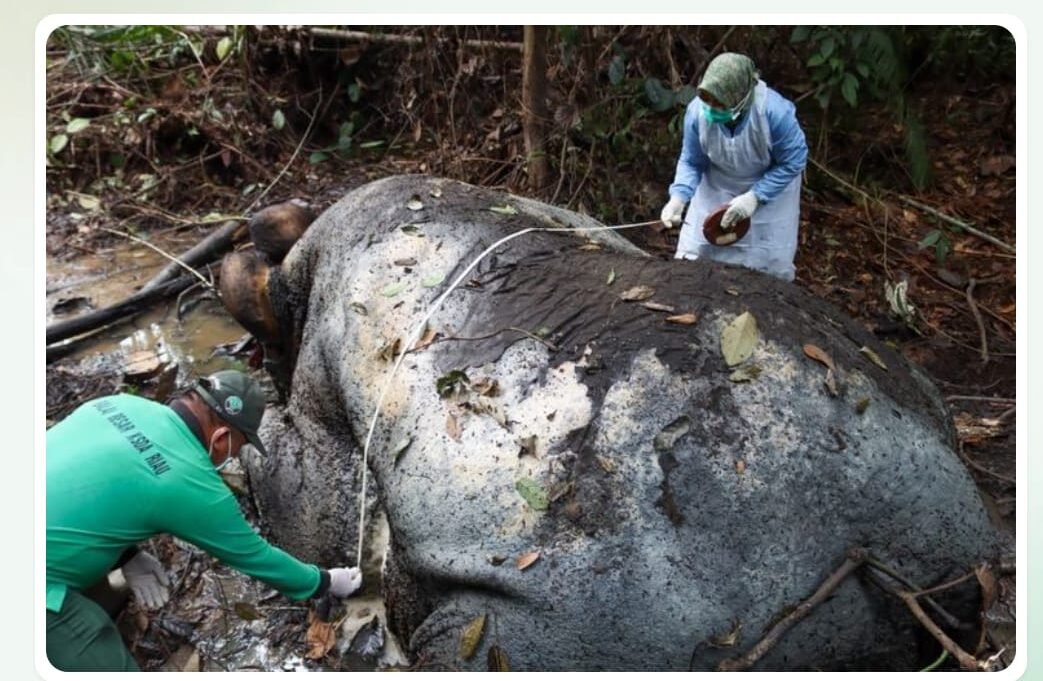
Source: kehutanan.go.id
Subsequent investigations conducted by the Riau Regional Police (Polda Riau), in cooperation with the Ministry of Environment and Forestry’s law-enforcement authorities, uncovered an alleged cross-regional poaching network involved in the illegal ivory trade.
By March 2026, authorities had reportedly identified 15 suspects, including alleged field executors, weapons suppliers, financiers, and ivory buyers, while three other individuals remained on the wanted list.
Investigators further stated that the network had allegedly been operating since 2024 and was suspected of involvement in the deaths of at least nine elephants in Riau between 2024 and 2026.
Authorities also reported the recovery of elephant tusks weighing approximately 7.6 kg, which were allegedly traded for as much as IDR 125 million. Some of the ivory was reportedly processed into cigarette pipes for further trade.
Following the case, the Ministry of Environment and Forestry summoned PT RAPP management to evaluate security and wildlife-protection measures within the company’s concession landscape and to strengthen safeguards for protected wildlife.
This case represents a confirmed example of elephant poaching associated with the illegal ivory trade.
CASE 2: WILD ELEPHANT CALF FOUND DEAD — SUSPECTED SNARE-RELATED INJURY
26 February 2026
On 26 February 2026, the carcass of a young wild elephant was discovered within the Lancang Kuning Resort area of Tesso Nilo National Park, Pelalawan Regency.
The elephant was estimated to have been less than five years old and had not developed large tusks, making it unlikely to have been targeted for ivory.
The carcass was already in an advanced stage of decomposition, indicating that the animal had likely died more than a week before it was discovered.
During the field examination, authorities reportedly observed distinct injuries and found a rope snare tightly entangled around one of the elephant’s legs. These findings raised strong concerns that the animal had suffered a serious snare-related injury, potentially resulting in infection and death.
Source: kumparan.com
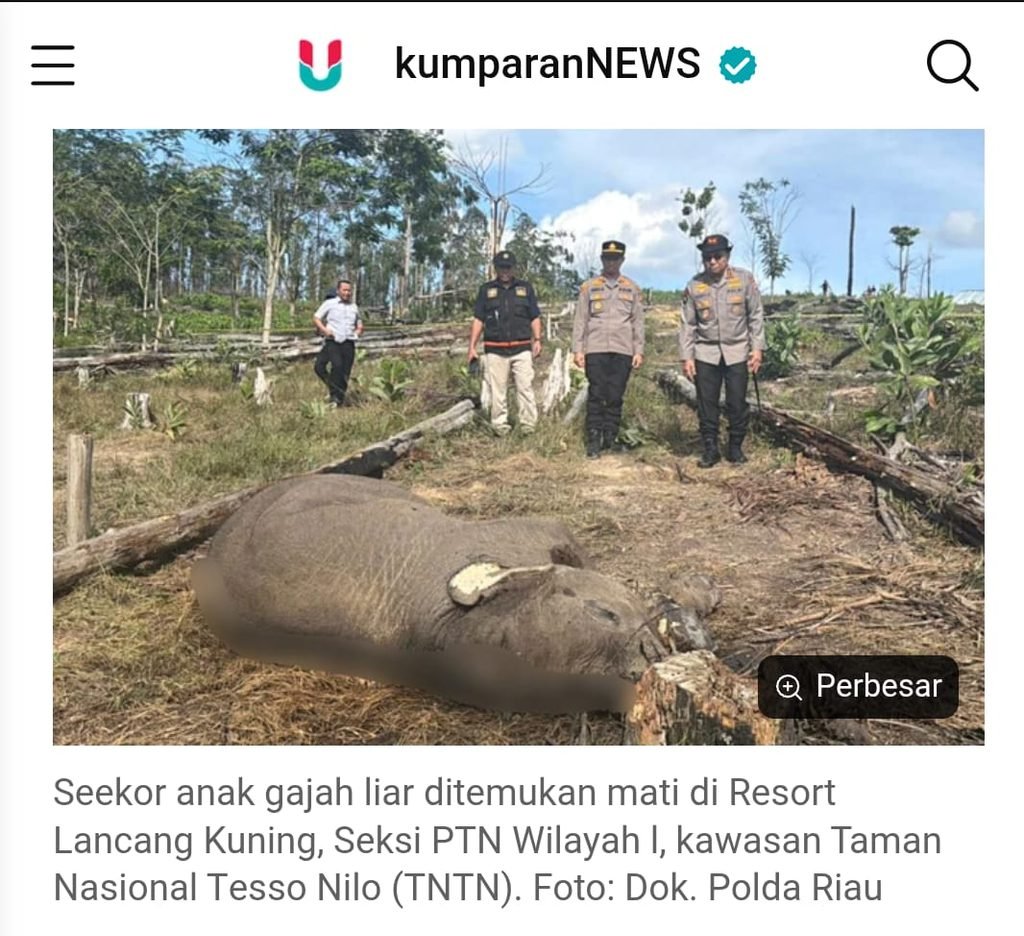
Source: kumparan.com
The Riau Regional Police Chief and the Head of BBKSDA Riau visited the location to conduct an immediate assessment of the incident.
On 2 March 2026, authorities officially designated JM, 44 years old, a resident of Lubuk Kembang Bunga Village, Ukui Sub-district, as a suspect in connection with the placement of illegal snares within the Tesso Nilo National Park zone.
Samples of tissue and internal organs were subsequently collected for laboratory examination and necropsy in order to establish the definitive cause of death.
As of 6 September 2026, the complete laboratory and necropsy results have not yet been publicly released. Therefore, the exact cause of death remains under investigation, although the presence of the snare represents a serious and documented conservation concern.
Authorities have also stated that, at the time of investigation, there was no strong evidence establishing that the calf had been killed for its ivory.
CURRENT SITUATION
As of 6 September 2026, BBKSDA Riau had not publicly released a comprehensive annual report compiling all wild Sumatran elephant mortality cases recorded throughout Riau during 2026.
Consequently, these two documented cases should not be interpreted as representing the total number of elephant deaths in the province during 2026. Additional incidents may have occurred but may not yet have been discovered, verified, investigated, or publicly reported.
Nevertheless, the two cases illustrate two distinct and continuing threats:
- The first demonstrates how illegal poaching and the ivory trade continue to drive the deliberate killing of adult elephants.
- The second demonstrates the danger posed by indiscriminate snares and traps, which can injure and kill elephants regardless of their age or whether they possess commercially valuable tusks.
For a species already facing severe habitat fragmentation, human-elephant conflict, encroachment, and declining connectivity between forest landscapes, every preventable mortality represents an additional pressure on the survival of remaining wild populations.
A CALL FOR STRONGER PROTECTION
Jelita Foundation calls upon all relevant stakeholders — including local and national government agencies, conservation authorities, forest and plantation concession holders, law-enforcement agencies, and local communities — to strengthen protection for wild Sumatran elephants across Riau.
Priority actions should include:
- Strengthening landscape-level patrols and wildlife monitoring.
- Increasing detection and removal of illegal snares and traps.
- Improving security and surveillance in elephant habitats and movement corridors.
- Pursuing wildlife-crime investigations and prosecutions rigorously.
- Strengthening cooperation between government agencies, concession holders, and local communities.
- Protecting and restoring critical elephant habitats and wildlife corridors.
- Improving rapid-response mechanisms for injured, trapped, or threatened elephants.
- Maintaining transparent public reporting of verified elephant mortality cases.
The Sumatran elephant cannot afford continued losses from preventable human activities. Protecting the remaining elephants means protecting the forests, corridors, and landscapes that sustain both wildlife and people.
SOURCES & REFERENCES
- BBKSDA Riau / Riau Regional Police — Joint press conferences, 6 February and 3 March 2026.
- Ministry of Environment and Forestry (KLHK) — Official summons and evaluation concerning PT RAPP, February 2026.
- ANTARA News Riau — Reporting on the alleged poaching syndicate and its suspected connection to elephant deaths since 2024, March 2026.
- Kompas.com — Reporting on the elephant found shot dead in Pelalawan, February 2026.
- Tesso Nilo National Park Management Agency — Field documentation concerning the wild elephant calf mortality, 26 February 2026.
- Riau Regional Police (Polda Riau) — Suspect designation announcement, 2 March 2026.
- Riau Provincial Media Center — Investigation and case updates concerning the alleged poaching network, March 2026.
📧 jelitafoundation@gmail.com | jelita@hutanriau.org